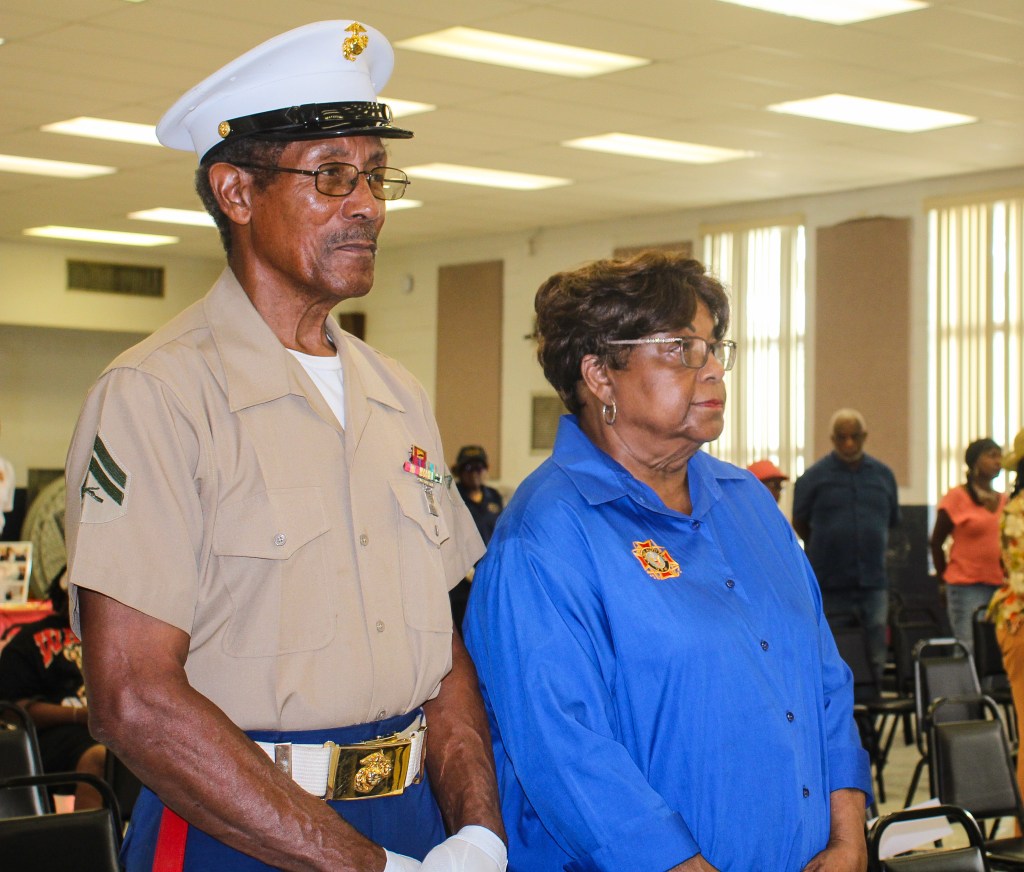
The legacy of Black military service took center stage this month with a museum presentation honoring the sacrifices of Black veterans and a library program highlighting the contributions of Black helicopter pilots during the Vietnam War.
Candace Shelton feels as America celebrates its 250th anniversary, it’s the perfect year for reflection.
To honor the sacrifice of Black veterans, she and other volunteers with the Friends of Marion County Black History Museum Inc. organized the America 250: Black Edition event on Thursday at the Marion County Black History Museum at Howard Academy Community Center in Ocala.
“Tonight, we gather not simply to commemorate 250 years of our nation’s history, but to illuminate a story that has too often been overlooked — a story of courage, sacrifice, perseverance, faith, hope and unwavering resilience,” said Shelton, the event host.
“We honor those whose names are well-known and those whose sacrifice may never appear in history books, but whose legacy lives on in their families and communities,” she said.
Bruce Seaman, guest speaker and author of “To Succeed Where Others Failed: The Untold Story of the Marshall Plantation Raid,” discussed the Marshall Plantation Raid, when a troop of Union soldiers raided the Marshall Plantation, a sugar plantation with 95 enslaved people working to harvest sugar and send food to the Confederacy in Ocala.
“There are people who spent their entire lives in Marion County and they have no idea this happened,” Seaman said. “Black history doesn’t often get as much attention as it justly deserves.”
Seaman explained the time line of the events that included soldiers traveling nearly 100 miles from Jacksonville to the Marion County plantation before traveling on foot 80 miles to St. Augustine. The raid was conducted by 16 soldiers from the 3rd U.S. Colored Troop Infantry, six soldiers from 34th U.S. Colored Troop Infantry, seven civilian scouts and one White soldier. The group left Jacksonville on a flatbed boat on March 7 and made it by foot to St. Augustine on March 12.
Seaman pointed out the Marshall Plantation raid was unique because it was among one of the first times a raid was planned, led and executed by Black soldiers.
He ended his presentation by noting the caravan escaped to St. Augustine on foot with 72 of 95 of the plantation’s slaves.
After his presentation, attendees explored an exhibit that featured a “Hero Wall” with more than 50 portraits of local Black veterans that were donated by community members.
William Vernon, of Ocala, was one of the veterans with his photo on the wall, along with his brother Donald, who was killed during the Vietnam war.
“I heard about the event and I almost didn’t come, but I’m glad I did,” William said. “It’s important to be here to talk about Black soldiers and all that we’ve done,” he said.
Before the museum presentation, the Marion County Public Library kicked off the conversation by shining a light on the 600 Black helicopter pilots who served during the Vietnam war.
Like most veterans, White or Black, Dr. Joe Ponds said he was hesitant to tell stories about his time overseas.
Sharing stories of the struggles he and other Black pilots faced overseas, Ponds gave his presentation, “Black Helicopter Pilots in Vietnam,” on July 2 at the Headquarters-Ocala Public Library in Ocala.
“Normally, veterans don’t tell you about what they went through,” said Ponds, president of the Vietnam Helicopter Pilots Association of Florida and author of “The 600 m.o.l. Black Helicopter Pilots in Vietnam.”
“I feel telling the story regardless of the audience is important,” he said. “There are young people who don’t know anything about the Vietnam War. Giving them the opportunity to speak with someone who was there and learn from a first-person perspective means so much.”
Briefly touching on his childhood and the mindset of society, Ponds spoke about the basic human rights and experiences he was denied at the time because of what he referred to as his ‘disability.’
“The disability impressed upon me by society is that I was born with the disability of being ‘colored,’” he said. “I was on my way to Vietnam to put my life on the line for the country when I didn’t have the same rights or privileges, but I went anyway.
“The life expectancy of a helicopter pilot in Vietnam was 30 days. After making it through that alive, we came home and were still subjected to sitting on the back of the bus or drinking from separate fountains,” Ponds said.
When the nation withdrew from the war and the need for helicopter pilots diminished, Ponds left active duty. He continued serving his country as a direct commissioned aviator in the U.S. Coast Guard in 1976, a position held by only six Black pilots at the time.
After returning home from the war, Ponds was diagnosed with post-traumatic stress disorder. He said he is both healing himself and educating others by “getting the story out.”
“Everyone has a story,” he said. “I’ve spoken to hundreds of people who have had a connection to someone who fought in Vietnam. Unfortunately most times they didn’t share their experience. You’d also be surprised just how many people didn’t know there were Black helicopter pilots in Vietnam. I hope that this spark someone’s interest and inspires people to give us the respect that we fought, wounded and died for. We were an integral part of the Vietnam war and American history. I pray it won’t be erased because I don’t want my life to be in vain.”
Staff writer Brea Jones can be reached at 352-753-1119, ext. 5414, or brea.jones@thevillagesmedia.com.

