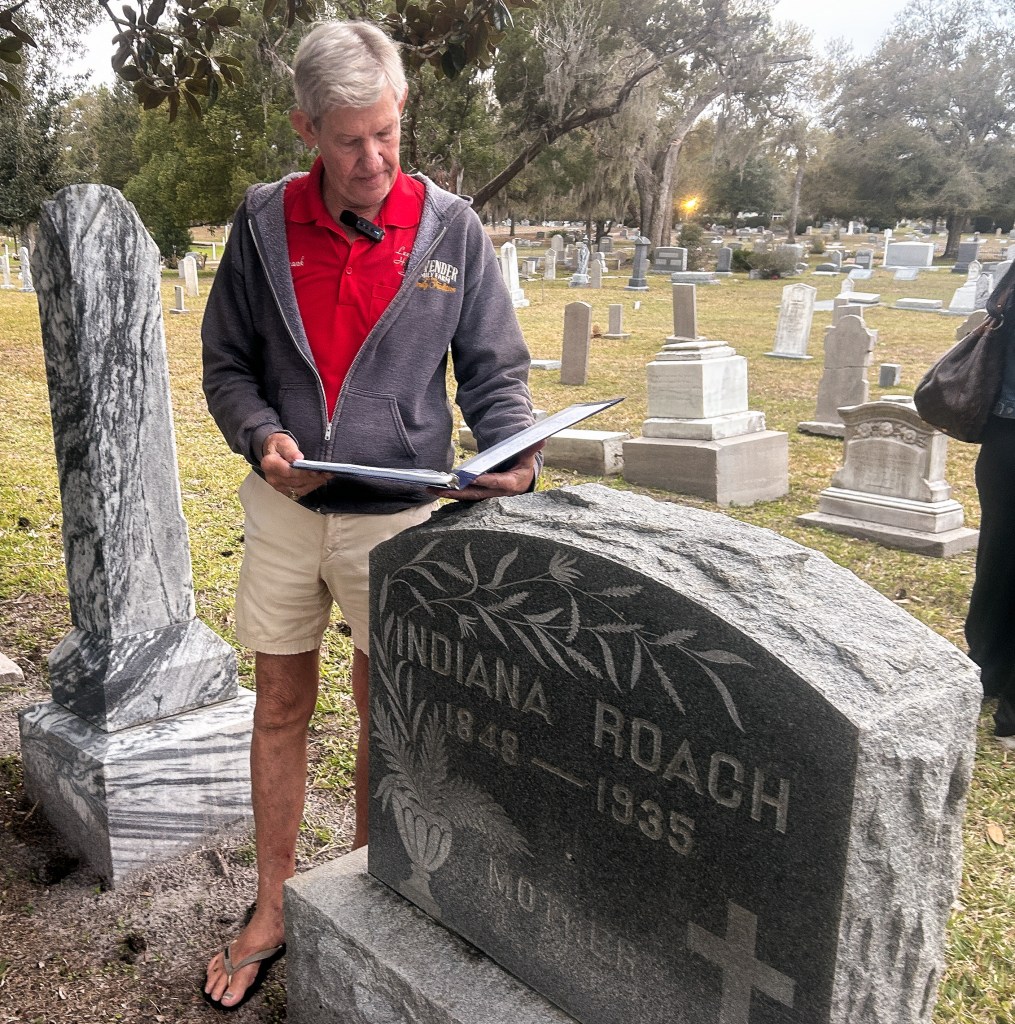
Relatives of Leesburg’s pioneers and longtime residents brought history to life on March 3 during Lone Oak Cemetery’s 12th annual Moonlight Tour.
Tracy Metcalf, Lone Oak Cemetery executive director, said the cemetery, at 306 Thomas Ave., Leesburg, has offered these tours nearly every year since 2012.
“The board thought it was a good idea to start the tour to bring awareness to our cemetery because a lot of people don’t know that we are here, although we’ve been here since 1867,” Metcalf said. “With the tours, we mainly want to show the history of Leesburg and the people buried here.”
The tours, she said, provide a way for the city’s residents to learn about their history.
“I learn different things every time we do the tour,” Metcalf said. “(The cemetery) is owned by the people. The history belongs to people that buy here.”
Five tour groups walked the cemetery grounds during the evening, with key stops including historic markers, such as the burial sites of famous residents, and the site of the city’s first Methodist church.
Residents visited the final resting places of Leesburg’s founding father, Evander Lee, World War II veteran Staff Sgt. Franklin Hall, whose remains were recently recovered after being missing for 79 years, and American sharpshooter Annie Oakley’s gunsmith George Waddas.
“Annie Oakley and her husband used to winter here, so she had her gunsmith with her,” Metcalf said. “Something else we are very proud of is that her dog, Dave, the famous dog that she used to shoot the apple off his head, we have his marker here. The dog was killed in 1923 on Main Street by an automobile, but when Annie tried to come here to bury him, we did not have a pet cemetery at that time and she was turned away. She and her husband Frank went out in the woods and buried him there and made a makeshift marker that was lost for 70 years.”
Metcalf said the marker for Oakley’s dog was found on private property. It was given to the cemetery board when the homeowner moved away several years ago.
“We erected a monument, including that marker dedicated to her and the dog Dave,” she said.
Behind the marker of Oakley’s gunsmith, a six-sided small structure stands in the same spot of the first permanent building for the Morrison United Methodist Church, built in three iterations from 1859 to 1875.
“First they built a brush arbor, then they built a log cabin and then it became a wooden structure,” said Beverly Ohnstad, one of the tour guides for the evening and a member of the cemetery’s board of trustees.
This year, the tour featured the story of the late Rev. Cecil Johnson, who ministered at First Baptist Church in Leesburg through 2019.
“Cecil was homeless and addicted to drugs, but he wanted to turn his life around, so he joined First Baptist Church of Leesburg in 1996,” said his wife, Victoria Johnson. “The Men’s Center of First Baptist loved him, helped him and nursed him.
“The movie ‘No Vacancy’ was inspired by his effort as one of the first people to donate money for the down payment on the Samaritan Inn. He started it out with $300, but it came from his heart,” Victoria said.
The Samaritan Inn, previously a vacant motel located across from First Baptist, is one of eight Christian Care Center ministries and is focused on providing housing for homeless children and their parents.
After speaking to the third tour group of the evening, Victoria said the experience has been humbling.
“I’m grateful and I’m humbled,” she said. “I now have people praying for me. Of course, I wish he was here with me, but I am thanking God for the life that we lived after finding each other. God redeemed us and I will never go back to that life. Someone needs to know that there is hope.”
Cecil and Victoria lived through similar experiences. She was addicted to drugs for 13 years before finding the church.
“Now, through my nonprofit organization Victorious Haven, we help women struggling with homelessness and addiction,” Victoria said. “We feed them, give them clothes and minister to them. It takes all of us to keep the community strong.”
Frank Stivender, of Leesburg, assisted as a tour guide for the evening, telling the stories of Indiana Roach, his great-great-aunt, and Evander Lee, his great-great-great-uncle.
“Evander Lee, the reason Leesburg got its name, was tired of going to Ocala to get shipping, so he sent his brother, Calvin, to New York (to intercept mail being sent to Ocala). When they said, where should we ship this to, he said to Leesburg.” Stivender, president of the Leesburg Historical Society and director of the Leesburg Historical Museum, said his pride in his family history started at a young age.
“My grandma, Nan Pennil-Stivenger, would drive us to Lone Oak to visit the graves and she would instill in us that we were descendants of the pioneers of Leesburg,” he said. “I want to do my part to make sure we don’t lose the identity of Leesburg and its history.”
John Hoornstra, president of the Lone Oak Cemetery board of trustees, said, as a Leesburg native, he feels it’s important to preserve and share the history of the town while respecting the remains of those who made that history.
“I was born and raised here in Leesburg,” he said. “I think it’s important to remember the history of the town. With the team in our office and the grounds people doing the landscaping work, everyone helps to keep this place in good condition.”
For more information about the cemetery loneoakleesburg.com.
Staff writer Brea Jones can be reached at 352-753-1119, ext. 5414, or brea.jones@thevillagesmedia.com.

