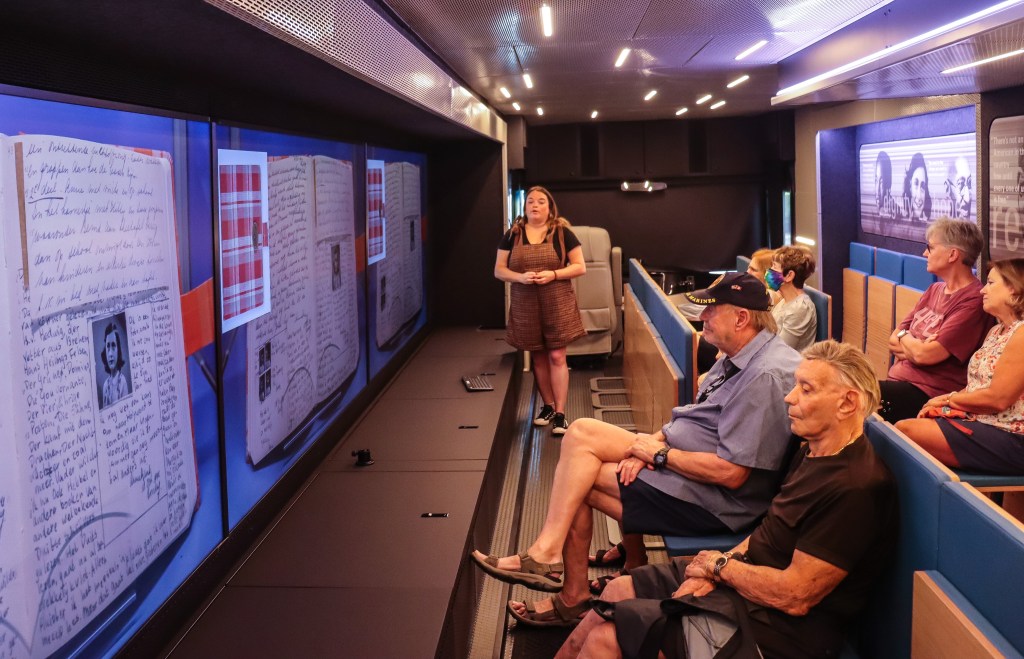
Museums enhance what is taught in classrooms by bringing lessons to life through workshops and films. That’s the goal of the Mobile Museum of Tolerance.
The 30-seat traveling educational center, which launched in Illinois and is based off the Simon Wiesenthal Center’s educational Museum of Tolerance in California, aims to combat antisemitism, racism and bullying with immersive technology and a licensed educator who teaches lessons on the Holocaust, Civil Rights Movement and handling online hate.
Kaitie Martinelli, an educator with the Florida-based Mobile Museum of Tolerance, said lessons from the museum have been used to inspire positive change for people of all ages and backgrounds, though lessons are designed for grades 5 through 14.
“Tolerance means having a general acceptance of your surroundings and other people,” Martinelli said.
Florida is the newest location to receive a bus. Other mobile museums are located in New York, Illinois and California.
The Florida-based Mobile Museum of Tolerance made its way to The Villages on Oct. 10, taking a day at The Villages Public Library at Pinellas Plaza. Martinelli said those who participated in the workshop for the day were some of the first people on the bus.
The museum’s next stop is the Bushnell Public Library, 402 N. Florida St., Bushnell, from 10 a.m. to 2 p.m. Wednesday.
The Anne Frank Story
Conversations of one of history’s darkest periods are still had nearly 100 years later to prevent it from happening again.
The Holocaust, which started in 1933 and officially ended in 1945, was the persecution and genocide of nearly 6 million European Jewish people during World War II. Anne Frank has become a highly discussed representation of the Holocaust because her published diary exposed the world to the horrors Jewish people endured during the war in detail for the first time. The Mobile Museum of Tolerance tells the story of Anne Frank using historical context and an immersive short film using Anne’s words. After viewing the video, participants defined and discussed stereotypes and antisemitism, hostility toward or discrimination against Jewish people.
“(Anne Frank) gives a voice to those who have been silent,” Martinelli said.
The museum’s Power of Ordinary People workshop teaches how propaganda was used to manipulate ordinary people using the Holocaust as an example.
The workshop invites participants to analyze the question “What leads ordinary people to commit acts of atrocity?” using examples of propaganda. Participants are also taught what it means to be an upstander, a person who stands up against injustice.
Civil Rights Workshop
While each person has their own identity, humans as a whole have more commonalities than differences.
The Civil Rights workshop started with a discussion about identity, along with the things a person can and can’t change about themself.
“(We want you to) think about things that you can or can’t change about yourself,” Martinelli said. “Celebrate yourself and others for who they are.”
That is one of the first lessons visitors learned while talking about the Civil Rights Movement, as well as learning about racism, segregation, nonviolent protests and the Declaration of Independence.
The conversation progressed to who obtained rights in a frequently discussed portion of the Declaration of Independence — “We hold these truths to be self-evident that all men are created equal” — and the groups of people left out of the carefully crafted document, including women and people of color.
Martinelli said until around the 1960s, two Americas existed with the notion of Black and White people living “separate and unequal.”
After a brief discussion, visitors watched a short documentary from the Simon Wiesenthal Center about the fight for equality from 1950 to 1960 by civil rights heroes during the peak of the Civil Rights Movement, with Martinelli pointing out that “it should be our mission to keep (Civil Rights heroes’) memories alive.”
A Digital Media Literacy Workshop
Media literacy is defined as the ability to access, analyze, evaluate, create and act using all forms of communication.
The U.S. Department of Homeland Security shared information about key steps one can take to increase digital media literacy, including identify the author, consider the source (and triple check), seek alternative viewpoints and think before you share. Knowing who created the message and why can prevent the spread of online hate or misinformation, information that is false but not shared with the intention of spreading harm.
Along with misinformation, the internet can spread malinformation, true information used out of context to mislead or manipulate; or disinformation, false information that misleads or manipulates a person, group, organization or country, according to The Department of Homeland Security.
While the digital age has made media consumption more complex, people can still apply the same media literacy skills that can be key to create a safe and informed community.
The museum’s Digital Media Literacy Workshop, a two-part workshop that covers “combat hate” and “fact or fiction,” shares the tools needed to easily spot harmful online media, stand up against hate and produce a positive online presence.
Staff writer Brea Jones can be reached at 352-753-1119, ext. 5414, or brea.jones@thevillagesmedia.com.

