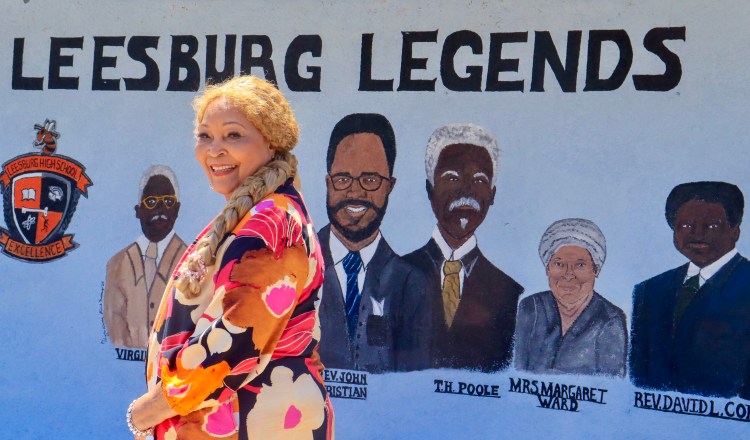
The Rev. John Christian made it his mission to preserve Pine Street.
The four-time former mayor of Leesburg – elected in 2005, 2008, 2014 and 2019 – said Leesburg’s historically Black community embodies and reflects the work of leaders from its recent past, including Virgil Hawkins, Betteye Stevens-Coney, T.H. Poole, Margaret Ward and the Rev. David Connelly.
A mural painted on the wall of the Pine Street Lounge, 323 Pine St. highlights that work and the positive impact these “Leesburg Legends” have had on the community.
“We decided the mural would highlight those who had a direct impact on the revitalization of Pine Street,” said Christian, executive director for the Community Development Corporation of Leesburg (CDC).
“Without them and the (CDC of Leesburg), Pine Street would’ve been a thing of the past.”
Christian means it liter-vally when he says that without some of the individuals featured on the mural, including himself, Pine Street wouldn’t exist as it is today.
The historic community houses thriving businesses and spaces for recreational activities, including a community pool, the Leesburg African American Museum, Three Generations BBS and the Bettye Stevens Coney Business Center of Excellence.
The fight to preserve the historic community began in 1992, when Hawkins former secretary Harley Herman filed a 42-page lawsuit on behalf of residents, accusing the city and Leesburg Regional Medical Center of destroying the predominately Black neighborhood to expand the hospital’s footprint. It was settled nine years later, with Pine Street residents and Herman being awarded $3 million.
Over the past 15 years, the CDC of Leesburg used that money to purchase two blocks in the historic community, acquiring land from the medical center and former residents.
Christian said the CDC of Leesburg’s goal is to revitalize Pine Street by increasing its economic value through thriving businesses and homeownership.
“As a 40-year-old from Leesburg, I should be able to afford to live in Leesburg,” he said. “Homeownership is a 30-year commitment people will make to protect their surroundings to not decrease property value. We spent 15 years buying lots of land to provide people with longevity. It’s about pride and community investment.”
Stevens-Coney, a retired Lake County teacher, believes creating a sense of pride among the youth is important.
“The lawsuit equipped the community with enough money to be thinkers and builders of our own,” she said.”When I learned the CDC gives the community autonomous control, I immediately knew that’s what we needed and made the motion. It all goes back to thinking outside the boundaries. I don’t see that progress can be made if you are busy worried about the criticism you’ll face.”
T.H. Poole, a former president of the Tri-County NAACP, was known for caring little about criticism.
The civil rights activist repeatedly fought in the courts to advance equal rights in Lake County by securing fair representation among Lees-burg’s elected officials, integrating the community pool and integrating the schools’ cheerleading squads. Poole also assisted in securing equal pay for Black teachers and equal representation for school administrators.
A fight that Stevens-Coney knew she had to join.
“That connected to the very basis of what it means to be fearless and bold,” she said. “I was never worried I would lose my job, because I knew I was good at what I did and could find work somewhere else if needed. I wouldn’t be content if I didn’t join the fight. I knew we were good enough and competent enough to be in the higher positions, so I put my life on the line.”
Christian understands it’s common for trailblazers to make sacrifices for the community, which is what he said inspired him to commission the mural that honors Leesburg’s Legends.
“People are always dismissing or downplaying opportunities or are viewed as troublemakers or agitators,” he said. “We should thank these people for what they did.”
Christian said Poole – the first person on the wall he met when he was first getting involved in community nonprofit work – taught him the formal side of business such as bylaws and Roberts Rules of Order, while Margaret Ward taught him more about relationships and representation.
Ward was an educator and the founder and CEO of The Dabney Manatee Heritage Group. She also was the former president of the 11th Episcopal District Women’s Missionary Society of the AME Church.
“Mrs. Ward was more the motherly type,” Christian said. “She was also a community advocate. She gave me advice to always have a suit and tie on because I am representing all of us. She was always uplifting the people and our community.”
Virgil Hawkins was known for fighting to integrate the University of Florida’s law school after suing the school in 1949 – though he himself was not allowed to attend the school as a stipulation of the ruling in 1958. He later received his law degree from New England School of Law in Boston and was admitted to the Florida Bar at the age of 69, 28 years after first applying at UF.
When Hawkins died in 1988, his four-hour-long funeral was presided over by the Rev. David Connelly, the minister at St. Stephens AME Church, the oldest Black church in Leesburg.
Connelly didn’t just serve his congregation. He was elected as the city’s first Black commissioner in 1986 and the first Black mayor in 1994.
“I’ve been in Leesburg public schools my whole life and had never heard of Virgil Hawkins. We had trailblazers in our community we knew nothing about.”
 breasbuzz.com