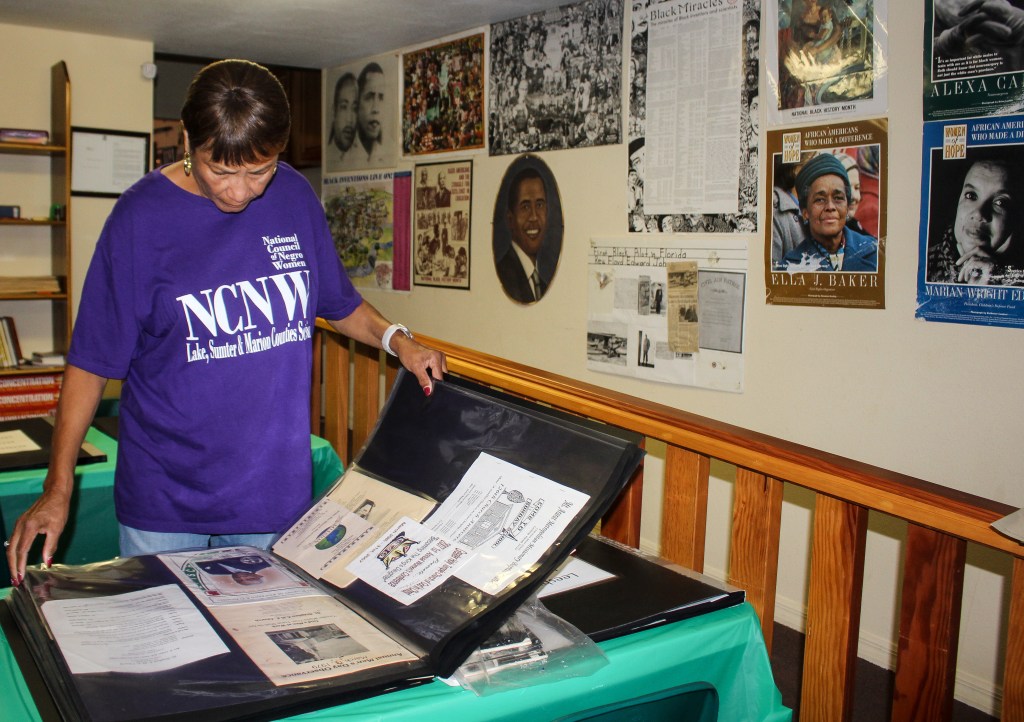
Lillian Lockette is determined to share some of Leesburg’s more obscure history with the community through the Leesburg African-American Museum.
She, along with other members of the Lake, Sumter and Marion Counties Section of the National Council of Negro Women, took almost seven months to sift through memorabilia, artwork, faded photographs and old newspaper clippings about Leesburg residents who contributed to the city and county’s development.
“This project has been a labor of love,” said Lockette, social justice chair of the local chapter of the NCNW. “When I noticed just how many people were not aware of our local history or that there was even a Black history museum in Leesburg, I knew I had to do something. I’m looking forward to seeing young folks come here to learn our history. Grandparents can bring their grandchildren to learn about African Americans who lived in Lake County.”
The museum, located at 220 Mike St., Leesburg, is open from 11 a.m. to 2 p.m. Monday, Wednesday and Friday, thanks to NCNW members volunteering to give tours of the center that was previously open by appointment only.
Once a home, the Community Development Corporation of Leesburg turned it into a museum around 2002 as part of its efforts to preserve the community’s Black history. It is the only African-American museum in Lake County and one of dozens of museums focused on Black history sprawled throughout the state, according to the Association of African American Museums.
The volunteers organized the museum into themed rooms — Education, Pioneer and Early Labor.
Starting with a mass of African masks in the foyer, moving to pictures of the first Black family in Leesburg in the Pioneer Room and ending with an exhibit about historic Black schools in the Education Room, the walking path through the museum intentionally follows the timeline of the African American journey in the United States from enslavement through the civil rights movement.
The walls of the museum are covered with articles and photographs of Leesburg’s most influential Black residents, including:
– John Butler and Mackey Wright Dabney of The Dabney Family, who were the first Black family to move to Leesburg in 1857. John Morgan Dabney, one of the couple’s 10 children, became the first Black teacher in Leesburg and a school principal.
– David Connelly, Leesburg’s first Black commissioner.
– Walter Berry, who became Lake County Schools first Black administration after a decadelong legal battle.
– T.H. Poole, former president of the Tri-County NAACP and civil rights activist, who fought to integrate Lake County community swimming pools and to ensure equal pay for Black teachers in the county.
Pastor John Christian, chairman of the Community Development Corporation of Leesburg, said, as a Leesburg native, the museum reinforces his pride in the community.
“Growing up here in Leesburg, we didn’t grow up hearing about Virgil Hawkins, T.H. Poole or other local iconic figures who made national changes throughout the legal system,” Christian said. “This is an opportunity for people to have access to history and have access to the facts of how we got where we are. This is an exciting time for our community to be able to learn more about Leesburg and Lake County, especially those who made such a positive contribution to said community.”
Shaun Wethington, president and founder of the Lake, Sumter and Marion Counties Section of the NCNW, said the experience of going through items at the museum was an eye-opener.
“It was overwhelming,” she said. “I grew up in Leesburg, so it was amazing to see how much the history went back. I recognized some events from when I was a little girl and I was able to tell some of the NCNW members that didn’t grow up here about some things we found while we were getting it organized. I think we spent more time, in the beginning, reading than we did organizing.
“I also saw a lot of newspapers about events that I’d forgotten about,” Wethington said. “When we looked at the articles, there were some happy times and some sad times — it was a lot of reminiscing. I even saw an article about my mom, Ida Rolle, who was the first Black cashier in the area. It was a nice thing we did separating everything and being able to identify different people who contributed to the community. “
Staff writer Brea Jones can be reached at 352-753-1119, ext. 5414, or brea.jones@thevillagesmedia.com.

