Art can cause people to focus on stories that might have been overlooked for centuries.
Aiming to highlight Florida’s role in national history through art and discussion, the Florida’s Eve of Emancipation event was Friday at the Fort King National Historic Landmark, 3925 E. Fort King St., Ocala.
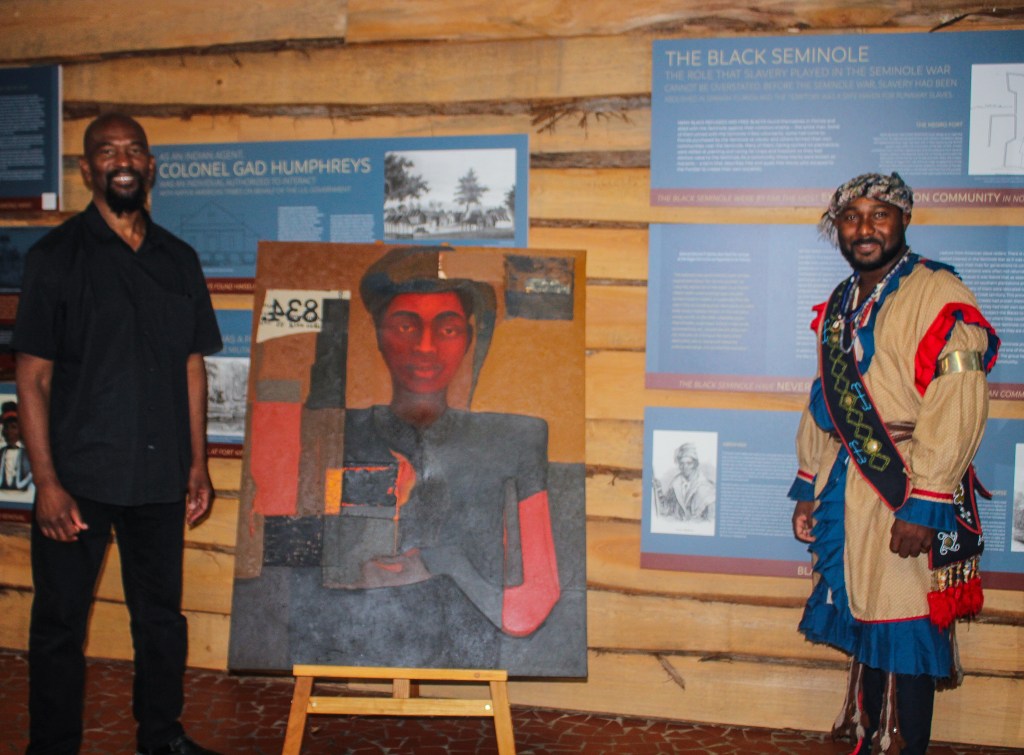
Along with unveiling an original painting by local artist Charles Eady, which depicted Abraham, a formerly enslaved Black man who lived near Ocala and became a lead interpreter for Seminoles during the Second Seminole War, the event included conversations about how slavery shaped relations and treaty negotiations between Seminoles.
“Fort King itself stands as a symbol of both U.S. expansion and Seminole resistance during one of the longest and costliest conflicts between the United States and Native peoples,” said Misti Barrett, City of Ocala public relations specialist.
Andy Warrener, City of Ocala outdoor and historical resource program coordinator, opened the event by highlighting moments in Florida’s history where formerly enslaved Blacks emancipated themselves from the 16-19th centuries.
He explained how on May 10, 1865, Sergeant Major Henry James led a troop of Union soldiers with the 3rd United States Colored Infantry in a raid on the Marshall Plantation, a sugar plantation that sent food to the Confederacy in Ocala.
The raid — which was the only Civil War event that occurred in Marion County — led up to Florida Emancipation Day, happening 10 days later.
The day honors the reading of the Emancipation Proclamation by Union troops in Tallahassee on May 20.
Nearly a month after enslaved people in Florida learned the news, enslaved people in Texas learned they were free on June 19, sparking Juneteenth, now a federal holiday.
Before unveiling his art at the Friday event, Eady gave a presentation titled, “Florida’s Underground Railroad: Route to Freedom,” which reflected on knowledge he’s gained during 17 years of research on free Blacks in the South before the Civil War.
His research led to him discovering Abraham.
Born in Georgia, Abraham spoke several languages, and was self emancipated after being enslaved in Pensacola. He lived in Pilaklikaha also known as Abraham’s Town, which was previously home to the largest Black Seminole community in Florida.
“Visual aids are important when it comes to history,” Eady said. “Images are very powerful and can help enforce a narrative. When researching, depictions and images look like free Blacks are begging, but they didn’t beg, they fought for their freedom. My goal is to create a more uplifting image that can better represent the person more. Those who self emancipated should be talked about more.”
Inside the Visitor Center of Fort King, an audience of about 20 people got the first glimpse of his artwork of Abraham titled “Before the Feather.”
It depicts a young version of him before the Seminole War ended using deep reds and dark blacks and blues.
Most images of Abraham is a black and white historical depiction making Eady’s work one of few in color portraits.
“I wanted to represent his character as a person who achieved great things,” Eady said. “I wanted him to feel resilient and determined. There’s an ‘entrance through the eyes’ that shows that.”
Matthew Griffin, a descendant of Black Seminoles and a historical reenactor, was the last speaker for the program.
Dressed in attire representing what Black Seminole wore during the war, he spoke about Blacks who fought with Seminole Indians to stay in Florida during the Second Seminole War and the Civil War, highlighting leaders like Abraham who influenced history.
Barrett said Eady’s art helps fill the gap of few visual records or firsthand depictions from Fort King during the Seminole War era.
“Most surviving information comes from military correspondence, government reports, archaeology and scattered historical accounts,” she said. “Because of this, artistic interpretation became an important tool for helping modern audiences connect emotionally and visually with the people who shaped this history.”
Florida Emancipation Day and Fort King both encourage a deeper public understanding of how freedom was contested and delayed, how different cultures interacted and how African American and Native people helped shape the development of Florida, she said.
“These discussions remain important because many of these stories were left out of traditional historical narratives for generations,” she said. “Public programs help preserve community memory, support historical scholarship and ensure that complex history is not forgotten.”
Staff writer Brea Jones can be reached at 352-753-1119, ext. 5414, or brea.jones@thevillagesmedia.com.

