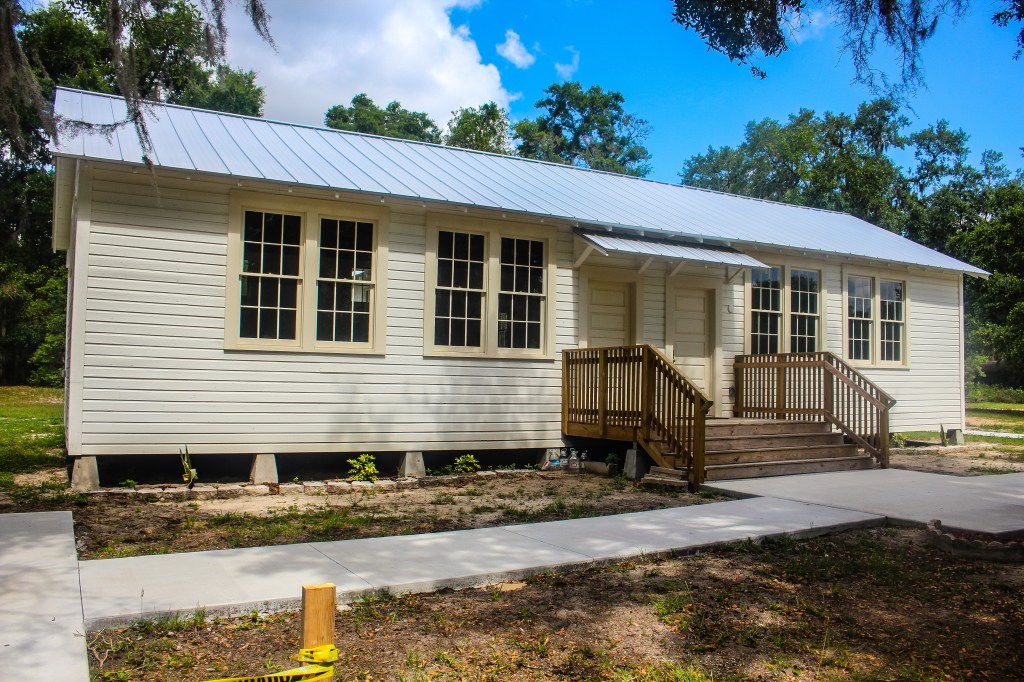
Members of Okahumpka Community Club are carefully reconstructing the past in an effort to educate the future.
Currently, a shell of what was once a two-room, wood-frame school for Black children, Okahumpka Rosenwald School is being recreated as a museum encapsulating the school’s legacy.
Harriet Hawkins-Livingston, a member of the OCC and a former student of the school, said she’s happy to see the progress on the restoration of the building built on land donated by her ancestors.
Hawkins-Livingtson is the niece of Virgil Hawkins, a civil rights attorney whose nine-year legal battle against the University of Florida led to the desegregation of Florida’s graduate and professional schools. Virgil’s parents donated the land where the Okahumpka Rosenwald School was built.
“It’s unbelievable to see the original school back like it was,” Hawkins-Livingtson said. “To me, it’s a lift to the community. The school and the churches were the center of the community at the time, so to see it back how it was — I think it’s amazing.”
The Okahumpka Rosenwald School operated between 1930 and 1964. After it closed, the building was briefly used as a community center.
One of more than 5,300 Rosenwald schools across 15 states, it was part of a project organized by Booker T. Washington, a Black author and educator who was born into slavery, and funded by Julius Rosenwald, a philanthropist and president of Sears, Roebuck and Co.
Of the 10 Rosenwald schools in Lake County, it’s one of two still standing today — the other is in Mount Dora.
The historical significance of the Okahumpka Rosenwald School was noted when the school was placed on the National Register of Historic Places in 2021 and the Florida Trust for Historic Preservation’s “11 to Save” list.
Barbara Nason, Okahumpka Community Club secretary, said the school is “the dichotomy of what was available to students in the Black community” at the time.
“With the Rosenwald School having been built during segregation in Okahumpka and another school for White children being just down the road, there was a big difference in what was provided to Black and White students,” Nason said. “I think it’s important for people to recognize that despite limitations, those students went on to be very successful people.”
Chip D’Amico, Okahumpka Community Club board-member, said since raising more than $1 million through donations and secured grant funding from organizations including the Florida Trust for Historic Preservation and the African American Cultural Heritage Action Fund, the OCC has worked to restore the building back to what it would have looked like when it opened.
D’Amico said since the groundbreaking for restoration in April 2025, they have made progress on restoring exterior walls using up to 80% of the original wood, replacing the concrete piers holding up the structure and replacing 18 windows and three doors.
There also are plans to add a bathroom and a septic system.
Despite setbacks and red tape over the years, Nason said club members are more determined than ever to get the project past the finish line.
“We are a very passionate group of people who I think are just incredibly stubborn,” Nason said. “We are not giving up.”
“The grant money needs to be used by the end of June,” she added. “We’re on track to complete (an Americans with Disabilities Act-compliant) restroom and complete the site improvements, including handicap parking and the trimming and plantings of trees. Then we will need to wait for the county to give us its certificate of occupancy.”
Hoping to help visitors visualize what it was like to learn at the school, the OCC plans to reconstruct one of the classrooms as an exhibit.
Desks for the classroom exhibit were built by the Plantation Woodworkers, a club of the Plantation at Leesburg community.
“We are in the process of analyzing our oral history videos,” Nason said. “We’ve done that so we can plan an exhibit that represents the folks who have contributed to sharing memories of what it was like when they went to the Okahumpka Rosenwald School. We hope to recreate what it was like to attend school there from first through fourth grade. … We will continue to find ways to incorporate who the teachers were to celebrate and
honor them.”As the OCC continues checking items off its to-do list, Nason and OCC president Charles Fields share the school’s legacy by meeting with other organizations in the tri-county area.
This year, Nason and Fields have presented to organizations including the Rotary Club of The Villages, Temple Shalom of Central Florida and the Lake, Sumter, Marion Section of the National Organization of Negro Women (NCNW).
“We often have talked about the Jewish and Black connection,” Nason said. “We share how the relationship between Booker T. Washington and Julius Rosenwald is an example of how important that connection is. Both individuals used education and philanthropy to support a group of people having access to better education. What we are talking about is the importance of people coming together to support community.
“We also talk quite a bit about the history of what was going on in the United States at that time,” she said. “One of my favorite sayings is, ‘We need boots on the ground.’ Though we still need funding for operational costs, we need boots on the ground. We welcome people to support our initiatives through volunteerism.”
Shaun Wethington, founder of the Lake, Sumter, Marion Section of NCNW, said the meeting with the OCC was impactful.
“Some of us had heard about the Rosenwald schools and some of us had not,” she said. “The presentation gave us great insight as to how that got started and who Mr. Rosenwald was. It was a very educational and impactful.”
Wethington said since learning about OCC and its mission, she has attended a few other meetings and shared its efforts with a local historic church. She hopes to spread news about OCC’s mission with other organizations in the summer.
“The Hawkins family attended St. Stephen African Methodist Episcopal Church,” she said. “So, I wanted to let them know about the OCC and efforts to restore the school. I think it’s important because just knowing your history is important. We also want to continue the legacy of the Hawkins family.”
While reconstruction and planning continues, the OCC continues to look for funding and ways to connect with other organizations.
“We can’t afford to lose what has been so important to so many,” Nason said. “Virgil Hawkins; Booker T. Washington; Julius Rosenwald; Charles Fields, our president; Thelma Smith, our vice president; Harriet Livingston and her cousin Bettye Stevens-Coney — all of these people care deeply about education and community. They care deeply about preserving history and having the truth continue, so we will keep working to do that.”
The Okahumka Community Club meets at 6:30 p.m. the second Thursday of every month at the Mt. Olive Baptist Church, 3720 N. Quarters Road, Okahumpka. Visit okahumpka.org for more about the club or to learn ways to participate in preservation efforts.
Staff writer Brea Jones can be reached at 352-753-1119, ext. 5414, or brea.jones@thevillagesmedia.com.

