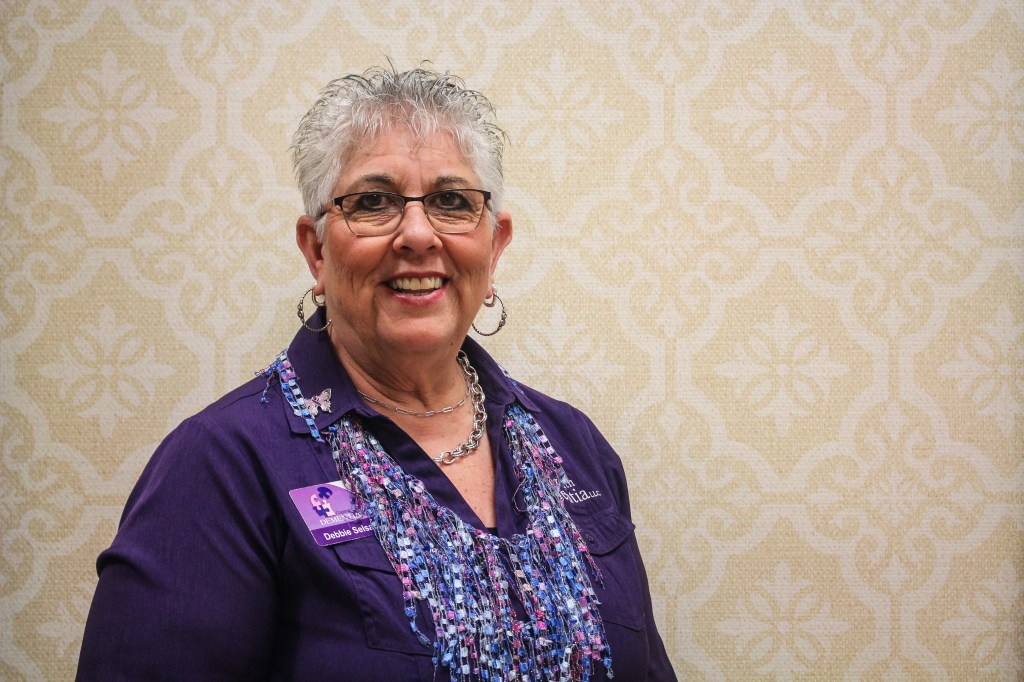
Debbie Selsavage is dedicated to providing information and resources to caregivers who are caring for loved ones diagnosed with dementia.
As a certified dementia practitioner and the co-founder of Coping with Dementia LLC, Selsavage has spent the last 12 years making connections by educating caregivers and local law enforcement in Sumter, Lake, Marion and Citrus counties about the disease and how to interact with those diagnosed.
“I want people to know you don’t have to do this alone,” Selsavage said. “So many people feel like they have to or they don’t know where the resources are. I want to provide resources for families. Mistakes are made because caregivers don’t know where to turn.”
In an effort to reach people caring for a loved one with dementia, Selsavage spent her afternoon April 22 meeting with members of The African American Club of The Villages at La Hacienda Recreation as a guest speaker for the club’s monthly meeting.
Dementia, which is an umbrella term for memory loss, causes damage to brain cells which affects behaviors and the way the brain processes information, according to the Alzheimer’s Association.
Alzheimer’s Disease is the most common form of dementia, affecting one in nine Americans over 65. It also is the sixth leading cause of death in America, according to the U.S. Centers for Disease Control and Prevention.
“This is the time our baby boomer generation is growing in age,” Selsavage said. “The baby boomers are the largest generation of people born at one time. So, the increase in the amount of people that are aging and living longer is why we are seeing an increase in dementia.”
During her presentation to TAAC, Selsavage said that she can relate to people who want to learn how to communicate better with their loved one who has Alzheimer’s diesease or another form of
dementia.
She was motivated to create Coping with Dementia after spending years caring for her husband, Albert, who had been diagnosed with the disease.
She shared how after caring for her husband for years, he was placed in an assisted-living facility. He ultimately had to leave for having what the facility described as violent behavior.
After he tried three assisted living facilities and was held under the Florida Mental Health Act, commonly called the Baker Act, Selsavage said that she finally discovered a solution at the last facility her husband stayed at before his passing.
“It was all because they couldn’t understand him,” she said. “At the last facility he was at, they kept giving him positive reinforcement. You have to learn to validate a person — it’s called validation
therapy.”
Developed by Naomi Feil, validation therapy is the process of validating a person’s reality and emotions instead of correcting them to help the person not feel ignored or dismissed.
“A person living with dementia works on how things make them feel,” Selsavage said. “They don’t forget you, they forget you in the way you remember the relationship. You have to adjust your perspective to their new reality. Go with them into their journey and they will be less frustrated, less stressed and less angry. ”
Selsavage explained how dementia affects the brain and can cause a person not to recognize their own face and to lose their peripheral vision, the triggers of hunger and thirst and more.
“They are dropping every fourth word,” she said. “So if you say, ‘Go get your jacket,’ what word did they not hear? Jacket. We have to change our expectations and stop blaming a person for doing what comes naturally to them. Go with them in their journey because the minute they lose trust in you is when you start to separate.”
She advised TAAC members to be understanding of where their loved one is at mentally on their journey.
At the end of her presentation, Selsavage opened the floor for questions or comments from TAAC members.
Jerome Lumpkin, of the Village of Hillsborough, shared his experience caring for his mother with Alzheimer’s disease.
“It’s difficult seeing your mother or anyone you love resort back to their childhood or any other phase in their life,” Lumpkin said. “The experience wore us down. We should take advantage of the information and resources she has so we can understand what’s going on as we care for our loved one.”
For more information about Coping with Dementia, visit coping.today.
Staff writer Brea Jones can be reached at 352-753-1119, ext. 5414, or brea.jones@thevillagesmedia.com.

