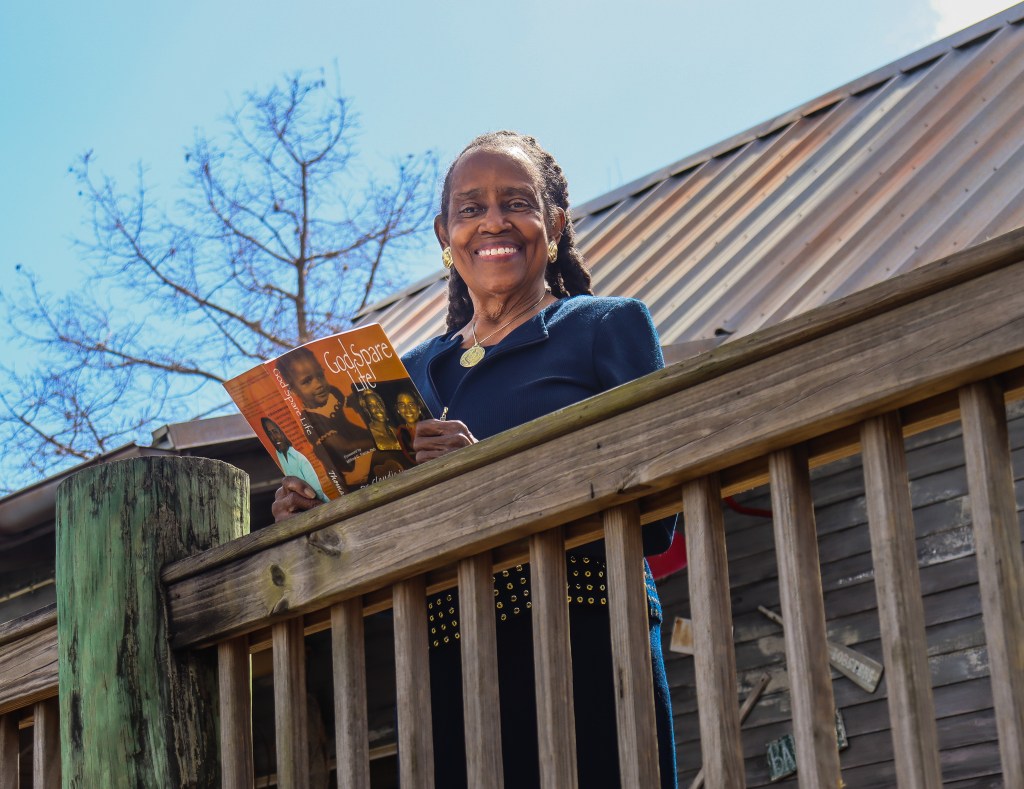
To Dr. Claudia Thomas, orthopedic surgery is an art.
Thomas, the first certified Black female orthopedic surgeon in the United States and the first woman to graduate from Yale’s orthopedic residency, said her love for art and the hand-eye coordination it requires was useful in her career as a surgeon.
“I was practical enough not to think I was going to be an artist in my lifetime, but I did think that medicine would be of interest,” said Thomas, of Lady Lake. “I didn’t really know what orthopedic surgery was until I was exposed to it as a student and I found that it was just fascinating — putting a body back together.”
Thomas shared her journey to becoming a leader in the orthopedic surgery industry during a talk on Feb. 25 at Villages Rehab and Nursing Center in Lady Lake.
“I liked the artistic side of surgery — molding, transforming and fixing things,” she said. “People came in broken or otherwise impaired and I had the opportunity to reverse the injury to put them back together again.”
Trinie Springer, activities director at the center, said her desire to bring in a unique presentation for Black History Month led her to learning about Thomas.
“I wanted to do something different and unique for Black History Month,” she said. “When I learned about her, I said, ‘We have to bring her.’”
From assisting with opening the Urban Center for Black Studies at Vassar College in New York to increasing the number of women students enrolled in the Johns Hopkins Department of Orthopedics residency program, Thomas influenced and inspired many people through the years.
As an undergraduate student at Vassar College from 1967 to 1971, Thomas led 34 Black female students in the Students’ Afro American Society to take over the college’s main building for nearly three days. The peaceful protest led to the school opening the Urban Center for Black Studies, implementing a Black Studies program and hiring a director for the program — thus doubling the number of full-time Black faculty at the school.
“I had come in (to Vassar College) as a math major and I loved math because of the problem solving,” she said. “Later, I switched my major to Black Studies and did my thesis on sickle cell anemia, which mainly affects people of color.”
Thomas, who had a newfound interest in health, applied to medical school and was accepted into John Hopkins University, where she said she discovered orthopedic surgery.
Thomas recalled her first live lab — a surgery on an African American teenager diagnosed with slipped capital femoral epiphysis, a hip disorder common in Black male teenagers that can lead to arthritis.
“I was invited to come up to the table and they said the hip bone had to be turned and pinned with screws,” Thomas said. “I said, ‘Oh I like that. That is an excellent idea.’ It got even more exciting when they gave me a pin and said, ‘Here Claudia, put this in.’ The doctor who developed the procedure I was scrubbed in on, Dr. Wayne Southwick, ended up being my chief at Yale, but here he was years prior at Hopkins showing us how to do this particular procedure. It unconsciously made me realize how there many diseases, like sickle cell anemia and kidney disease, that are particularly more severe for African Americans.”
Thomas asked the audience what they knew about orthopedic surgery or surgeons. Several in the audience replied that every orthopedic surgeon they ever had encountered was a man — something Thomas said she noticed early on.
“I fell in love with orthopedics,” she said. “But there was one problem — I didn’t see many women doing it. It wasn’t a field that appealed to women and it wasn’t a field, according to some of my colleagues, where women belonged. I spoke to one of my senior residents and said, ‘I love this stuff, but I don’t see many women doing this.’ He said, ‘ There’s no reason you can’t do this,’ which inspired me. It was his encouragement that made me apply to residency programs throughout the country. I saw something that I liked. I was good at it, so I pursued it.”
After John Hopkins, Thomas became the first woman to train in and graduate from the Yale Orthopedic Residency Program. She said by researching procedures in the Yale library and being innovative in the operating room, she became confident in her work and popular among the senior residents.
“It was as easy for me as it was for the men,” Thomas said. “Though some things are very hard — like putting a hip back into place. So, I made up my own method. There are procedures that were not even written up when I was a medical student and I had the opportunity to get involved in designing ways to fix things that had not been published. I just loved it. I was at a dinner at a Yale Club that was honoring Dr. Southwick, and a 6’6 gentleman who was a resident under me said if you ever had a hip you couldn’t get back into place then you needed to call Claudia. Apparently, I’d developed a reputation for reducing this type of disorder and getting the dislocated hip back in place.”
After her time at Yale, Thomas completed a fellowship at the R Adams Cowley Shock Trauma Center at the University of Maryland in 1980 and then returned to Johns Hopkins Department of Orthopedics a year later as an assistant professor. During that time, she helped increase the number of minority and women students enrolled in the program.
“Now there are more than 100 Black women practicing orthopedics today,” she said. “We’ve gone from one to over 100. How do you do that? People have to see you. When they see you walking down the halls, you turn and smile rather than turn away — that is an inspiration right there. I got to know residents, the fellows and those who thought about orthopedics but didn’t think they were capable, and I talked them into giving it a try. If I can help you along, if you want to be what I am, I will help and encourage you. You tell me you want to be a nurse, I’m going to try to talk you into being a physician. That’s probably why so many people know who I am — it’s from seeing me, being exposed to me and seeing me succeed.”
After getting married, Thomas moved to St. Thomas in the U.S. Virgin Islands, where she said key events occurred that solidified her faith in God and love for family.
Almost immediately after surviving a life-threatening experience on the island during Hurricane Hugo in 1989, Thomas battled bilateral kidney cancer. After she received a kidney from her older sister, Catharine, Thomas returned to her career as a non-operating orthopedist.
Thomas said that being autoimmune compromised because of her kidney means she must be cautious in public to prevent getting sick. She recalled to the audience contracting an illness that led to her becoming a patient at Villages Rehab and Nursing Center.
“I ended up in here unconscious,” she said. “I couldn’t tell you who the president was or even who I was. I’ve walked down these halls many times with a walker. I went through physical therapy and eventually got well enough to go home. Now I’m strong and in my right mind, I say to give you hope and faith in your own life and situation.”
Peggy Coffman, director of therapy at Villages Rehab and Nursing Center, said she first met Thomas several years ago after she diagnosed her mother with stage 4 cancer.
“Every time I see her I’m grateful because of how she handled the situation,” Coffman said. “My mom was going to her because she thought she needed surgery. Dr. Thomas was the one who had to tell her it was cancer. She did it with such compassion and was so kind. She gave my mom her cellphone number said she could call her anytime.”
Thomas — who has practiced in Maryland, Florida and the U.S. Virgin Islands — joined the private practice at the Tri-County Orthopedic Center in Leesburg in 2004. Over the years, she has continued to mentor youth, held positions including founding member and former president of the J. Robert Gladden Orthopedic Society, and received the American Academy of Orthopedic Surgeons Diversity Award.
Honoring the time when she couldn’t tell her own story, Thomas dictated her life in her autobiography, “God Spare Life.” Thomas said she feels the book’s title, a common expression in St. Thomas, reflects the times God spared her life.
To get a copy of Thomas’ autobiography or book her as a motivational speaker, visit claudiathomasmd.weebly.com.
Staff writer Brea Jones can be reached at 352-753-1119, ext. 5414, or brea.jones@thevillagesmedia.com.

