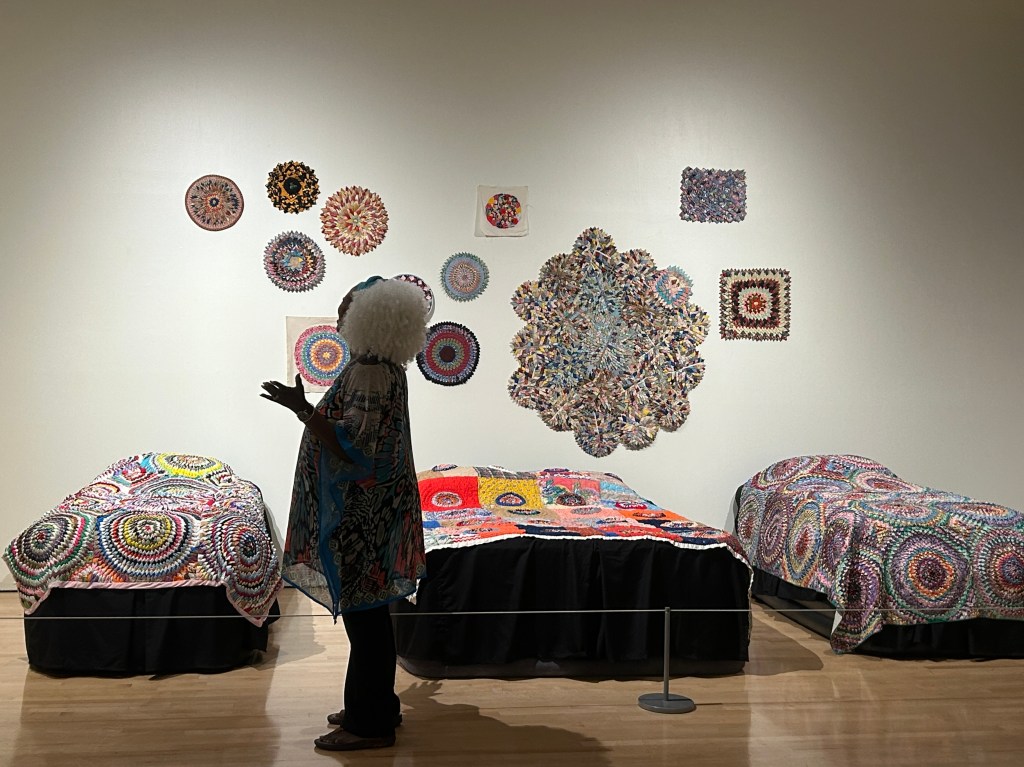
Betty Ford-Smith can captivate an audience.
Both her hand-stitched pine cone quilts and welcoming personality charmed visitors at the recent opening of “Under the Cover of Knowledge: Betty Ford-Smith’s Pinecone Quilts” at the Appleton Museum of Art. The exhibit is a colorful display of the artist’s work, from a 20-pound quilt to a small circular corsage.
“It’s like handwriting,” Ford-Smith said about her quilts. “It can’t truly be copied. Even when I’m in a good mood or a bad mood, I can tell the difference in my sewing. These quilts are like memories.”
The tradition of pine cone quilts, also known as pine burr, dates back to the Lumbee mixed-race community and Southern African quilters in the early 19th and 20th centuries.
The technique, which is made by sewing folded triangle fabric side by side in a concentric circle, is common in locations where pine trees exist, such as North Carolina, South Carolina, Georgia and Florida.
Jason Steuber, director of the Appleton Museum of Art, said the exhibition is designed in three parts — past, present and future.
“Betty is as vibrant and life-affirming as the pine cone quilts she creates,” Steuber said. “The artistic pine cone quilts draw you in while you become spellbound by their colors and fine handmade craft. The exhibition shows how nature inspired the creation of something that’s been needed and taught for over two centuries.
“The scale of the pine cones, that’s what (Ford-Smith) is mimicking,” he said. “There’s art in nature and nature inspires art through her idea of continuing the knowledge she is preparing us all for the future.”
The opening reception for the exhibition took place Sept. 5 for museum members, with the public being able to get their first look the following day during the museum’s monthly First Free Saturday event.
Ford-Smith, who made appearances on both days, spoke with museum guests about her 20 years of pine cone quilting and how she learned the traditional craft from Arlene Dennis, whom she affectionately calls
“Miss Sue.”
“A friend of mine introduced me to Miss Sue’s quilts first,” she said. “When she showed me, I had never seen anything like it. It was so right there in your face with the design and I was so excited. I said, ‘You have to introduce me to her.’
“She took me to a house that had a little sign on it. I passed it every day and never noticed it,” Ford-Smith said. “She was a little shy lady, and she was (wary) when I first asked to learn from her because no one had ever asked before. She looked at me like, ‘You’re really going to try this?’”
After convincing the 92-year-old to teach her the craft of pine cone quilting, the two worked together for six years before Dennis’ death in 2010. It took three months to complete the two quilts Ford-Smith worked on during their time together.
Ford-Smith’s first quilt, an 80 foot-by-68 foot, 17-pound piece named “Susie Q,” features rings illustrating shades of lavender, burgundy and green. Her second quilt, “Ring of Time,” was named People’s Choice at quilt shows in 2006 and 2017.
Ford-Smith, who recalls making quilts at Dennis’ home in front of a wood-burning fireplace, said quilt-making became a little bit of a competition between the two.
“I didn’t want her to beat me, but she did,” Ford-Smith said. “She made her squares bigger than mine.
“Miss Sue would put fabrics in a box and stir them up,” she said. “I do better when I have mine laid out. I prefer to go in a fabric store than order fabric online. I have to touch it, see it, smell it. I get mesmerized looking at fabrics.”
Ford-Smith first learned to hand-sew from her mother, who made her sew a skirt and a blouse before she could get her first sewing machine at 16, and her home economics class, which led to a lifelong interest.
“I wanted to be a fashion designer,” she said. “I went to an all-girls college (Bennett College) where I studied fashion design, art, dance, music and drama. But there weren’t many opportunities for a girl who looked like me in ‘71.” For over 38 years, Ford-Smith put her passion for fashion on hold to work as a teacher and later as a high school principal, working with emotionally disturbed and special needs students.
Since reacquainting herself with fabrics, Ford-Smith has received international acclaim.
Ford-Smith has five king-sized quilts currently traveling all over the world — including one of her heaviest, a 50-pound quilt hanging at the Smithsonian American Art Museum Renwick Gallery. There also was a video of her quilting that was played behind the Copenhagen Philharmonic Orchestra last year.
Ford-Smith is working to preserve the tradition of pine cone quilting across the globe, including by teaching workshops in France and being featured in a German magazine. She’s also written a book titled “Pinecone Quilts: Keeping Tradition Alive” in which readers can learn more about her story and quilting techniques. The book is available on Amazon and in the Appleton Museum of Art’s bookstore. “In the book, I talk about how (Miss Sue) and I met, the tradition of quilts and African patterns. I also have three quilting patterns in the book,” Ford-Smith said. “I want people to continue the joy and necessity of hand-sewing. Whenever I do lectures, there’s someone who asks, ‘Can you make it on a sewing machine?’
“You have to want to learn,” she said. “For younger people, it’s important to know how to sew. The idea is to be able to sit with yourself and your thoughts.”
The “Under the Cover of Knowledge: Betty Ford-Smith’s Pinecone Quilts” exhibit runs through
Feb. 22, at the Appleton Museum of Art, 4333 E Silver Springs Blvd. in Ocala. For more information, visit appleton museum.org/exhi bitions/under-the-cover-of-
knowledge/.
Staff writer Brea Jones can be reached at 352-753-1119, ext. 5414, or brea.jones@thevillagesmedia.com.

