Dr. Porchia Moore is passionate about preserving history and teaching others to do the same.
“I want to capture memories and stories. Memory isn’t flat; it’s multidimensional, connected to sound and smell,” she said. “For memories that can’t go into a box, people should make a list and write down things that can help them recall the memory.”
Moore, director of graduate studies for museum studies at the University of Florida, shared her love of history on May 29, during the Black Beauties and Silver Springs: A Paradise Park Memory Project event, the first of a series hosted by Moore.
“This is the launch of a longer multimedia and social media project about the suppressed history of Black people and leisure in the outdoors,” said Moore, who’s also the associate director of the Center for Arts, Migration, and Entrepreneurship at UF. “We have beauty pageant winners still living; their memory is important.”
While sharing memories of Paradise Park, the segregated counterpart attraction at Silver Springs State Park for African Americans open from 1949 to 1969, nearly two dozen people gathered for an energy-shifting community workshop at the Howard Academy Community Center in Ocala.
The community center, which houses donated and loaned artifacts that tell the rich history of Black people in Marion County, ironically is an artifact of history itself.
Established in 1866 by the Freedmen’s Bureau, Howard Academy was the first school for African Americans in Ocala, though the original structure was destroyed by a fire a year later and moved a short distance. By 1927, the school was one of a few awarding high school diplomas to African American students in Florida, and later became one of the most prestigious Black schools in the state before it closed in 1955.
Today, the community center serves as an operational base for several programs, including the School Board Title I offices, tutoring and mentoring programs, a community garden and the Marion County Black History Museum.
The meticulously organized museum has been maintained by volunteer Cynthia Wilson-Graham, a longtime Marion County resident and co-host of the workshop.
Using a collection of historical photos and information about park employees, Wilson-Graham curated an exhibit about Paradise Park’s legacy. She was motivated to share the park’s history because she didn’t learn about it herself until 2005, decades after becoming a Marion County resident and after taking hundreds of trips to Silver Springs State Park.
“I’ve been here most of my life and have worked for Head Start for 20 years,” Wilson-Graham said. “After, I saw this vintage photo of Black people on a boat in the museum, and it gave me a feeling of uncertainty. I asked individuals about what I later learned was Paradise Park, and found out it was about 1 mile from Silver Springs. I had been to Silver Springs hundreds of times and had never seen it or anything talking about it.
“We have so much hidden history right here in this county,” she said. “Our history must be told. We must tell our stories one story at a time.”
Aiming to help tell the story of the segregated park, Wilson-Graham co-authored “Remembering Paradise Park: Tourism and Segregation at Silver Springs” in 2015 with Lu Vickers, a professor at Tallahassee State College.
On behalf of Moore, workshop participants were gifted a copy of Wilson-Graham’s book, which Moore said inspired her to start the memory project.
The book details with interviews and vivid photographs how the free-entry park was founded and drew crowds of 100,000 people traveling from as far as New York and Alabama annually to enjoy the reptile exhibit, alligator attraction and glass-bottom boat rides navigated by Black boat captains on the Silver River — like Capt. Virginia Ferguson.
Also known as the Queen of the Silver River, Ferguson was the first woman — Black or White — to get her U.S. Coast Guard captain’s license in the state of Florida and the first female glass-bottom boat captain at Silver Springs. She worked at the state park for 46 years until her passing in March. The workshop is dedicated to Ferguson’s memory and the memory of living legends of Paradise Park. The Marion County Black History Museum now stores Ferguson’s pristine captain’s uniform and hat, loaned to Wilson-Graham for the exhibition on Paradise Park and Ferguson’s legacy.
Barbara Brooks, of Marion County, said the park experience “was like family all around.”
From swimming in crystal-clear water to dancing The Swing, The Twist and The Slow Drag on the Paradise Park dance floor — something not included on the Whites-only side of Silver Springs, along with the jukebox and picnic tables — former parkgoers said the experience was a “true paradise.”
The park was featured in The Green Book, a guide for African Americans to travel safely during segregation, and a 1953 copy of Ebony Magazine, which promoted the park as “the newest and largest recreation facility for Negroes in the South.”
In the summer, the park was known for its annual Labor Day beauty contest hosted by a local chapter of the American Legion to crown Miss Paradise Park.
Following in the footsteps of her mother, Alfronia Johnson, Carrie Johnson Parker-Warren won the ninth annual Miss Paradise Park contest in 1957. Her mother won second place in the first pageant and her sister also competed and placed.
During the memory workshop, Johnson Parker-Warren shared memories of winning the beauty contest and of her school days at Howard Academy.
Though her mother also participated in the contest during its first year, Johnson Parker-Warren said it was her Howard Academy gym teacher, Lottie Donaldson, who convinced her to participate. As a part of the Paradise Park exhibit at the Marion County Black History Museum, photos of Donaldson swimming underwater are featured in several promotional photos and videos for the park.
“That contest gives you a thrust of confidence,” Johnson Parker-Warren said. “Today, I try to be beautiful within. Beauty should begin there.”
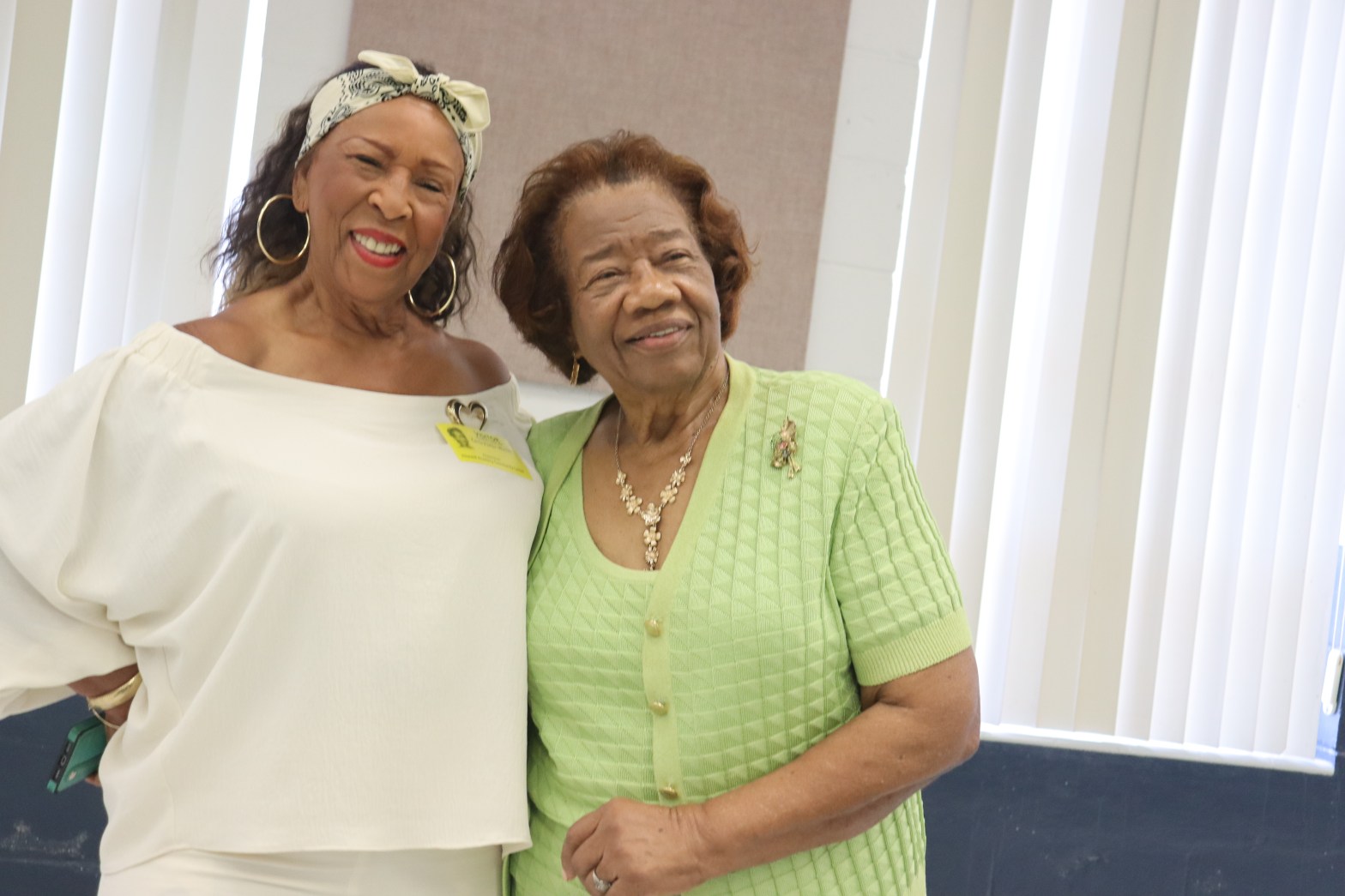
Photos of the Johnson women are also on display at the museum, along with a sleek black 1950’s-style swimsuit donated by Martha Thompson, the 1958 Miss Paradise Park and another former student of Howard Academy. The donated swimsuit was worn by Thompson when she won the pageant.
In between Thompson and Johnson Parker-Warren sharing memories of time spent at the park and their school days, workshop attendees listened in awe and captured the beauty of the pageant contest winners with photographs and autographs.
Also during the workshop, Moore explained how to preserve family photos and sensitive documents using an acid-free archival storage box. She advised after making a list of tangible and intangible memories, people find other ways to store memories that can’t go into the box.
“Get a journal and jot down notes, get a digital recorder to record the stories you have,” Moore said. “Have discussions about privacy and secrecy. Have clear rules of ‘This is the information that I want shared and this is how I want it to be shared.'”
To preserve history in the making and capture the conversations during the workshop, Moore worked with G5 photography to take video and photographs.
Wayne Hopkins, an Ocala native and G5 Photography business owner, also was surprised he was hearing about the park for the first time when he stepped into the museum, saying, “Some things don’t have a price on it.”
Moore feels now is the time to preserve Black history before those who lived it pass on.
“When an elder dies, a library burns down,” she said.
For footage of the workshop or to learn more about Moore’s work, visit drporchiamoore.com or g5photography352.com.
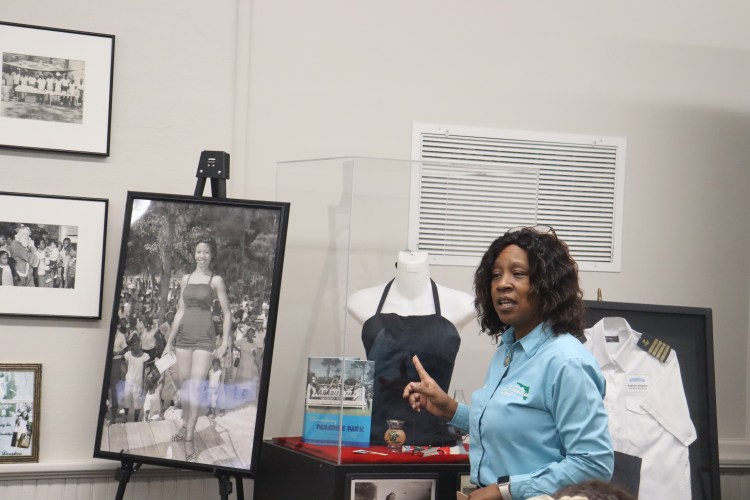
Cynthia Wilson-Graham, volunteer with Marion County Black History Museum, shows Martha Thompson’s bathing suit worn during her Miss Paradise Park win. The bathing suit is on loan as a part of the Paradise Park exhibit at the museum.
 breasbuzz.com